Fire Emblem Genealogy of the Holy War Box Art
From Burn Emblem Wiki, your source on Fire Emblem information. By fans, for fans.
| ||||||||||||||||
| ||||||||||||||||
| ||||||||||||||||

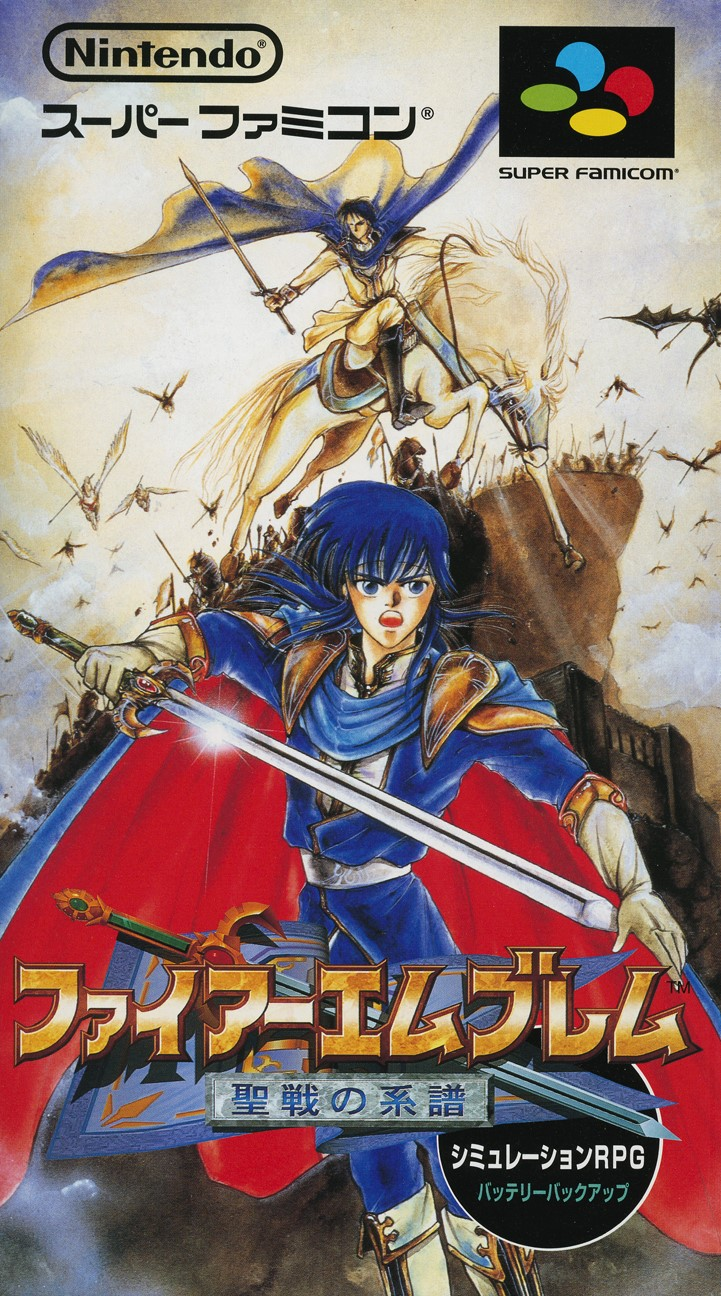
Fire Keepsake: Genealogy of the Holy War (Japanese: ファイアーエムブレム 聖戦の系譜 Fire Keepsake: Genealogy of Holy-War) is a turn-based strategy role-playing game released in 1996 for the Super Famicom, exclusively in Nihon. It is the fourth game installment in the Burn down Emblem series, and the second for Super Famicom; it is also the final game produced for Nintendo by Gunpei Yokoi before his departure from the company. It is a afar prequel to its predecessors, Shadow Dragon & the Blade of Light and Mystery of the Emblem , set over a thousand years in those games' past and in a different function of the world; contemporaneous events and civilizations from Archanea are referenced in the game.[2]
Genealogy of the Holy War is set in Jugdral, a land whose rulers comport the holy bloodlines of the Twelve Crusaders. The game is carve up up into 2 halves, separated past the timespan of a generation. In the first generation, while most of his nation's army is off to war in the eastern nation of Isaach, Lord Sigurd defends the duchies of Grannvale from a sudden invasion by the neighbouring Kingdom of Verdane, but is quickly embroiled in a conspiracy against his father, Byron, in the events which ultimately lead to the birth of the Grannvale Empire, and in the machinations of the Loptr Church to create a man vessel for their dark god Loptous - the same tyranny fought by his son, Seliph, seventeen years later on in the 2nd generation.
Plot
Hundreds of years before the beginning of the game, the world of Jugdral suffered under the grip of the Loptrian Empire, whose lineage of emperors acted as vessels for their "dark god", the earth dragon Loptous. This changed in the year 643 with the Miracle of Dahna, where twelve dragon gods led past Naga descended upon the urban center of Dahna, the last breastwork of a battered resistance force, and bestowed their power upon twelve warriors. These twelve became the Twelve Crusaders, and nether their leadership the Loptrian Empire fell after a decades-long holy war. The Crusaders then parted, with seven of them forming the Kingdom of Grannvale and its six duchies, while the other v founded their own kingdoms: Isaach, Agustria, Silesse and Thracia, which itself later on partially splintered off into the Munster Commune.
First generation: Sigurd'south story
Verdane'south invasion
- Main manufactures: Birth of a Holy Knight and Lady of the Forest
In the year Grann 757, war was first, with the bulk of Grannvale's army deployed to Isaach in retaliation for what they perceived to be an unprovoked strike confronting Dahna. With no perceived opposition, King Batu of neighbouring Verdane took the opportunity to launch an invasion of Grannvale at the behest of Sandima of the Loptrians, and his son Munnir conquered Yngvi Castle and abducted its Lady Edain. In response, Sigurd of Chalphy led his limited forces in defense force of Grannvale and pursuit of Edain, after joined by Quan of Leonster and his wife Ethlyn, Sigurd's sister, and past Lex of Dozel and Azelle of Velthomer. Later on reclaiming Yngvi and realizing that Edain had been captured, Sigurd was visited by Velthomer's Lord Arvis, who passed on the well-wishes of King Azmur and a Silver Sword.
Later seizing the adjoining Evans Castle, Sigurd received a regal messenger informing him of his elevation to the status of "Holy Knight of Grannvale", and and so led the grouping in a directly foray into Verdane itself. On the way, he encountered the errant Princess Ayra of Isaach, forced to serve Verdane while her nephew Shannan was held hostage. Sigurd liberated Shannan and convinced Ayra to defect to his army. Meanwhile, Prince Jamke released Edain and Dew from their imprisonment, then left to confront his male parent nigh his misgivings over the invasion. Batu continued to parrot Sandima's claims and defenses and ordered Jamke to launch a full offensive against the invaders, only afterward Jamke left, Sandima attacked Batu for asking questions about his claims. Afterwards acquisition Marpha Castle, Sigurd encountered Deirdre; the two instantly became enamoured with each other, but Deirdre nonetheless fled. They met once more as his forces passed through the Spirit Wood, and Deirdre offered to help in combating Sandima and confessed her newfound love for Sigurd.
After killing Sandima and conquering Verdane Castle, Sigurd found the dying Batu, who passed on to him the news of the machinations of the Loptrians, their efforts to revive their "night god" and how they had infested much of the world. Some time afterward, Sigurd and Deirdre married.
Set on from Agustria and subjugation
- Chief article: Crisis in Agustria
Agustria'due south rebellion
- Main article: Eldigan, the Lionheart
Exile and civil state of war in Silesse
- Main commodity: Dance in the Skies
Render to Grannvale
- Main article: Doorway to Destiny
2d generation: Seliph'southward story
Uprising in Isaach
- Main article: Heir of Light
To the rescue of Leonster
- Chief articles: Across the Desert and The Wyvern Knights of Thracia
Invading Thracia
- Main article: For Whose Sake
The final battle against Grannvale
- Master commodity: End of the Holy War
Gameplay
Genealogy of the Holy War is an unusual animate being among the series. Its general gameplay is rather different, and information technology boasts a large number of unique systems and features alongside introducing several gameplay points which would go on to become series staples.
Holy Claret and Weapons
- Principal article: Holy Blood
One of the cadre themes to the game is the legacy of the Twelve Crusaders, reflected in gameplay with the Holy Blood organisation. Some units possess one of thirteen lineages of holy blood, which enhance the unit'southward growth rates and weapon levels. Holy blood comes in 2 forms, minor claret and major blood; characters with minor blood receive the standard stats bonus and ane more level to its weapon, while characters with major blood are gifted with double bonuses and a * rank in the Crusader'due south weapon.
- Example: Azelle, a Mage, possesses small-scale Fjalar holy blood. As a result, he starts with a C rank in thunder and wind magic merely B in fire magic; without it, he would have had C in the three, as that is the rank borne past all Mages. He also receives a bonus increase of 20% to his HP growth rate and of 30% to the Magic growth rate, the bonuses given by the Fjalar blood.
With each holy blood lineage comes an associated holy weapon, one the weapons once wielded past the Twelve Cruasders. Only the crusaders' descendants who have inherited major holy blood can wield them, with ane such descendant normally beingness born per generation. These weapons are vastly more powerful than normal weapons, but their maintenance is conversely much more expensive.
Beloved and children
- Main article: Dear
With the game split into ii generational parts, a key aspect of this is that many of the units of the second generation are the children of those of the commencement. During the offset generation, the female playable units (except Deirdre and Ethlyn) can be paired up to fall in love with male person playable units and comport 2 children, who volition go on to comprise the majority of Seliph'due south army in the 2nd generation. As long every bit they fall in dear and remain live until the finish of Sigurd'southward story, their children volition be available in the 2nd half; otherwise, they volition be replaced with a matching substitute character who fills their role in the story.
- Master article: Inheritance
This is one of the main factors in Genealogy of the Holy War'south replayability; since the women can be paired with almost any men, who heavily influence the children, units in the second generation are quite variable. A kid's stats, growths and skills are determined past those of their parents, and then different fathers will yield different combinations and appropriately different results. Additionally, a child's starting inventory is mostly comprised of the inventory of their aforementioned-gender parent equally of the finish of the first generation, though they volition only inherit weapons if they are capable of using them by default with a few exceptions.
Skills
- Main commodity: Skills
Genealogy of the Holy State of war was the debut of the skills arrangement, abilities possessed past individual units designed that tin change the course of a battle. Here, skills are classified into two groups, albeit some of them, such as Follow-Up, can be in both.
- Personal skills: These are skills that are inherent in some units. They tin can be passed down to children.
- Example: Tailtiu, a Thunder Mage, has Wrath as a personal skill. No other units of that class have such skill in the first generation.
- Class skills: These abilities are present in all units of the course. They cannot be inherited.
- Example: All Generals, Barons and Emperors take Pavise, which gives the ability to receive no damage from the enemy's attack.
These abilities are a factor to be taken into account when battling, as they give the characters an edge over their opponents - skills are not limited to playable characters.
Skills can also exist passed downwards; the children volition have the personal skills of both of their parents. The only exception to this rule are the three "sword skills": Astra, Sol and Luna, which can only be inherited past not-mounted, sword-wielding children.
Outside of inheritance, this incarnation of the skills arrangement is the just one where skills are completely static and cannot exist removed, swapped or otherwise externally altered.
Weapons
Unlike other games where weapon durability is more variable and limited, nearly weapons in Genealogy of the Holy War have a durability of fifty uses. Subsequently that they break, as normal, but the remnants do not disappear as in other games. In allied castles, weapons can exist taken to a weapon repair shop to be restored to full uses, for a fee equivalent to a portion of their worth depending on how many uses need to be restored. On the other hand, their availability is very express; there are not many of each type, and only some bosses give one when defeated.
Also unique to Genealogy is its weapon kills stat, which corresponds to the amount of enemies defeated with an private weapon. Once it reaches 50, the weapon gains the Critical skill. For each killing after the fiftieth, the bonus increases*. Conversely, the standard crit stat usually possessed by weapons does non exist in lieu of this organization; the few killer weapons which exist in the game instead requite the Critical skill by default.
Inventory and funds
Related to the weapon changes, the game introduces 2 unique restrictions on item access and funding. First, items cannot exist freely traded between units, and instead must be sold and re-bought at pawn shops in order to be transferred to other units. Different other games, there is a set pocket-size number of weapons which exist in the game, and duplicates are seldom available; this actually has its benefits, as information technology mandates consistently repairing and reusing the same weapons, slowly improving them through the weapon kills mechanism, and these weapons are passed down from get-go-generation units to their 2nd-generation children. No consumable items exist in Genealogy, with the only non-weapon items in the game being stat-boosting and skill-granting rings.
The army's funds are at present also decided on an individual basis. Every unit of measurement has their ain supply of gold, obtaining more from saving villages, and rely heavily on their gold for repairing their weapons and exchanging items. For the most function, units are non allowed to swap gold with each other, with the exceptions of married couples being allowed to give each other their gold, and Thieves - whose Steal skill allows them to regularly get more than gold - can give their aureate to any unit.
Weapon triangle
- Principal article: Weapon triangle
Genealogy of the Holy War marked the debut implementation of another serial staple: the weapon triangle. In its incarnation in this game, whenever a unit of measurement attacks, they receive a xx% bonus to their hit rate if their weapon bests the enemy's pick according to the weapon triangle; should the opposite state of affairs be true, though, the unit receives a penalty of 20% to their hitting rate.
There are two weapon triangles, 1 concerned with physical weapons and ane wtih tomes:
- Physical weapons: Swords -> axes -> lances-> swords
- Tomes: Burn down magic -> air current magic -> thunder magic -> fire magic.
Bows, low-cal and dark magic are excluded from these triangles. Light and dark magic are both strong against fire, current of air and thunder, while bows are completely unaffected.
Characters
- Principal commodity: List of characters in Fire Emblem: Genealogy of the Holy State of war
The cast of Genealogy of the Holy War is divided roughly equally by generation. 24 units are playable in the first generation, while 25 are playable in the second generation, counting child units and their equivalent substitutes as one unit per pair; withal, in the 2d generation, only 24 are playable in a given playthrough, every bit the player must cull betwixt recruiting Iuchar and Iucharba. Finn is the only grapheme to be playable in both generations. The game's full playable cast - first generation, second generation, both children and substitutes - consists of 62 characters.
Although the actor has access to fewer classes than in other games, they cover the whole weapon and almost all magic spectrum; the merely enemy-exclusive form of assault is Dark magic.
The post-obit tabular array shows the mothers, their children and their respective substitute character:
| Mother | Children | Substitutes |
|---|---|---|
 Deirdre |   Seliph and Julia | North/A |
 Ethlyn |   Altena and Leif | N/A |
 Edain |   Lester and Lana |   Deimne and Muirne |
 Ayra |   Scáthach and Larcei |   Dalvin and Creidne |
 Lachesis |   Diarmuid and Nanna |   Tristan and Jeanne |
 Silvia |   Lene and Coirpre |   Laylea and Charlot |
 Erinys |   Ced and Fee |   Hawk and Hermina |
 Tailtiu |   Arthur and Tine |   Amongst and Linda |
 Brigid |   Febail and Patty |   Asaello and Daisy |
Chapters
- Main article: List of capacity in Burn Emblem: Genealogy of the Holy State of war
At twelve chapters, Genealogy of the Holy War is ostensibly the second-shortest game in the series, behind Gaiden ; however, each chapter is more comparable to numerous individual chapters contained within ane, being enormous and requiring the seizing of multiple castles per chapter. Information technology is as well the only game in the series where the entirety of gameplay takes place on exterior siege maps, with none of its activity occurring within cities, villages, castles, fortresses, ships or anything similar.
Development
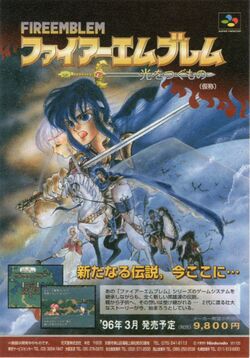
An early promotional leaflet for the game, which was called Fire Emblem: Heir of Light at the time.
The game which eventually evolved into Genealogy of the Holy State of war was non originally conceived as an actual Fire Emblem game, and many of the initial plans for the game deviate greatly from the finished product. According to Shouzou Kaga, one aim which led to the development of Genealogy was to temporarily break away from the Archanean setting to exercise something new with the series, similarly to Gaiden .[2] The initial concept for the gameplay had more in mutual with traditional Japanese function-playing games and was based around squads, where the player would motion squads of ten characters across a world map and would encounter and battle enemies. Withal, every bit the evolution continued, the game somewhen shifted dorsum to playing more like a traditional Fire Emblem game, based on both feedback from Nintendo and opinions among the team. Due to all of these changing plans, according to Tohru Narihiro, the Genealogy project was scrapped and remade from scratch at to the lowest degree ii or iii times. The development of the game was farther complicated by both staff and function changes at Intelligent Systems, which resulted in Yuka Tsujiyoko and her sound team staying behind at their sometime location while the rest of the squad worked at their new role.[iii]
When he was writing the scenario of Genealogy, ane of Kaga's primary aims was to produce a big-scale historical drama where the world undergoes great alter over a period of time and, in his words, "the history [is] the protagonist".[2] Equally function of this, Kaga also wished to convey how many historical events and behaviours are unpalatable by modern standards (citing patricide and incest equally examples) every bit a key theme and, to a lesser extent, how people's mistakes ended upward changing the world.[4] In this, he was adamant not to whitewash history and sought to nowadays a medieval drama reflective of the true nature of the era,[5] and to nowadays both the heroes and the villains every bit fighting for their own justice to emphasize the dangers posed by branding a conflict a "holy war" on either side.[6]
Many of the gameplay changes Genealogy engendered are claimed past Kaga to have been direct inspired by this scenario direction. The game's enormous maps were intended to change the impression delivered by prior games that the conflict was being fought on a small calibration, instead emphasizing the game'south events as a massive, earth-sweeping conflict. The changes to the game'south inventory and money systems, limiting the power to swap items between units and giving each unit their own personal money supply, were developed in a bid to residual out which units are used past players, discouraging dumping every resources into a small handful of units.[two]
Although the generational divide was a major element of the finished product in both gameplay and story, information technology was not office of the original concept that became Genealogy. According to Narihiro, the idea of adding an chemical element of romance was proposed partway through by Kaga based on the popularity of romance games at the time. The idea of inheritance based on variable parents, Narihiro suggests, likewise derives from Kaga's fondness for horse racing (probably by analogy with how retired champion race horses are used to breed more than horses).[three] Once the 2d generation became function of the plan, Kaga planned Genealogy to be a 3-part work, with a third segment post-obit Seliph's story. Its intent was to straight face and clarify the moral bug raised by the balance of the story and properly resolve loose threads. However, time constraints forced Intelligent Systems to cut this part entirely, with the game ending with Seliph's story.[v]
During its development, Genealogy was tentatively titled Fire Keepsake: Heir of Light (Japanese: ファイアーエムブレム 光をつぐもの), a title which even appeared on a publicly released promotional leaflet for the game (although the affiche did mark information technology as only a temporary name). The final release all the same has an advent of this subtitle, as the name of Chapter 6, and the title was likewise used as the title of a manga adaptation of the game.
Game credits
- Game Designer, Scenarist / Director: Shouzou Kaga
- Super Advisor: Keisuke Terasaki
- Cheaf[sic] Usher: Tohru Narihiro
- Technical Advisor: Toshiyuki Nakamura
- Programmer: Kouichi Abe, Toshiaki Yonezawa, Keiji Nanba, Mitsuru Matsumoto, Manabu Shimada, Takahiro Ohgi
- Graphic Designer: Fumika Noichi, Katsuyoshi Koya, Masahiro Higuchi, Azusa Iwamoto, Naoko Kugo
- Audio Creator: Yuka Tsujiyoko, Kenichi Nishimaki
- Art Work: Masafumi Sakashita, Fujiko Nomura, Yasuo Inoue, Yusuke Nakano, Noriyuki Sato
- Assistant: Kaori Aoki, Hiroshi Tanigawa, Masaya Kuzume, Yutaka Maekawa, Hirokazu Goutani, Hiroshi Takemoto
- Special Cheers To: M. Okada, Thousand. Nishizawa, K. Sugino, Y. Katsuki, T. Nagareda, Yard. Nishimura, K. Ikuno, G. Yamada, O. Yamauchi, Thousand. Yamamoto, T. Harada, H. Yamagami, N. Ozaki, M. Okuno, R. Kitanishi, M. Okuda, K. Sengoku, K. Yamafuji
- Producer: Gumpei Yokoi
Reception
As of 2002, Genealogy of the Holy State of war was the second-all-time-selling Fire Keepsake game, having sold an estimated 498,216 copies in its original Super Famicom print run.[seven] The official US English website for Fire Emblem: The Blazing Blade alleges that Genealogy was the near successful Burn Keepsake game in Nippon,[8] but information technology is uncertain how truthful this claim is in light of all other evidence pointing to Burn down Emblem: Mystery of the Emblem historically holding that title.
Fan translation
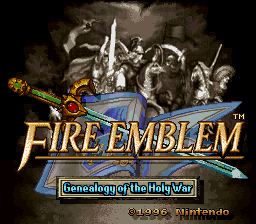
The title screen in the "Project Naga" fan translation of Genealogy of the Holy State of war.
- Main article: Fan translation#Burn down Emblem: Genealogy of the Holy War
Genealogy of the Holy War was the first Fire Keepsake game to receive an unofficial translation patch, with a subset of noted defunct fan translation grouping j2e working on the game betwixt 2000 and 2002. The group ultimately disappeared and left the patch unfinished, in a state that was "not to be enjoyed"; through the following decade, Twilkitri and other contributors picked up where j2e left off and connected to work on the patch, although both the programming and parts of the script remain incomplete. Several forks of Twilkitri'due south work have arisen over the years with diverse aims and additions.
In 2016, on the 20th ceremony of the original release of Genealogy of the Holy War, the first consummate translation patch for the game was released as a public beta. This patch, known as the "Project Naga" translation, features a total retranslation of the script including the previously unfinished epilogue, a new, slimmer font which allows for much more text to fit into the windows, and also fixes numerous glitches from the original game. It is currently completely playable, simply every bit a beta, it still has various technical errors which are currently being identified and corrected through feedback from players.[9]
Trivia
- Genealogy features the simply classes with the ability to utilise almost the entire weapon/magic spectrum: the Master Knight, which wields everything except night magic, totalling the ability to wield nine weapon types, and the Baron, wielding everything except light and dark magic. No other playable grade in the series ever has access to more than four weapon types; the simply other class in general to exceed this number is Gild Incarnate, a boss-exclusive course, with access to six.
- Along with Thracia 776 , Genealogy of the Holy State of war is the merely game in the serial which existed equally of 2008 to not be referenced at all in Super Boom Bros. Brawl; every other game in the series which existed at the time has some degree of representation, whereas Genealogy and Thracia do not.
- Along with Gaiden , Genealogy is one of the only games in the Burn down Emblem series where it is not possible for attacks to deal zero harm nether ordinary circumstances. Unless the Pavise skill blocks an set on, every set on that successfully connects with its target will deal an absolute minimum of 1 striking indicate of impairment, even if the target'southward defensive stat is much higher than the attacker'south crime.
- Genealogy is the simply game in the Burn down Emblem series where attack speed and avert can be negative.
Etymology and other languages
| Names, etymology and in other regions | ||
|---|---|---|
| Language | Name | Definition, etymology and notes |
| English | Fire Keepsake: Genealogy of the Holy War | As of Burn Emblem Enkindling. |
| Japanese | ファイアーエムブレム 聖戦の系譜 | Officially romanized equally Fire Emblem: Genealogy of Holy-War . |
| Castilian | Fire Emblem: Genealogy of the Holy War | As of Fire Emblem Enkindling. |
| French | Burn Emblem: Genealogy of the Holy State of war | As of Fire Emblem Awakening. |
| German language | Burn down Emblem: Genealogy of the Holy State of war | As of Burn Emblem Awakening. |
| Italian | Fire Emblem: Genealogy of the Holy State of war | As of Fire Emblem Enkindling. |
Gallery
-

Japanese box fine art of Genealogy of the Holy War.
-
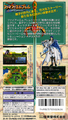
The back side of the box of Genealogy of the Holy War.
-

Japanese logo of Genealogy of the Holy War.
-

Full box artwork of the game (cropped from the instruction booklet'southward cover page).
-
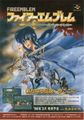
Promotional leaflet for Genealogy of the Holy War.
Screenshots
-
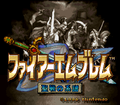
Japanese title screen of Genealogy of the Holy State of war.
-
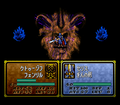
-
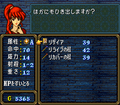
Concept artwork
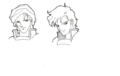
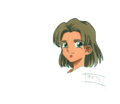
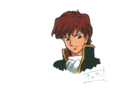
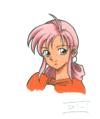
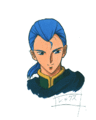
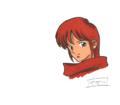
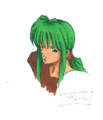
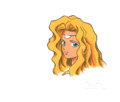
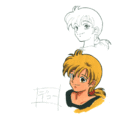
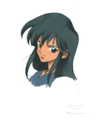
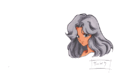
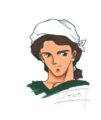
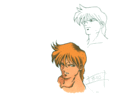
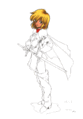
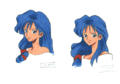
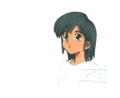
Concept fine art formerly present on Intelligent Systems' official website. The character and grade concept art are by Katsuyoshi Koya, and the parcel illustration proposals are past Naoko Kugo. This web page besides had images of fliers and advertisements for the game, but none were archived and the images are presumed lost.
- Character illustrations (Part 1)
-
-

-
-
-
-

-
-
-
-
-
-
-

Ayra 2.
-
-
-
-
-

-
-
-
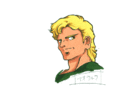
-
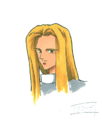
-
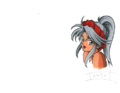
Tailtiu. The image labels her as "Eltiu" (エルテュ).
-
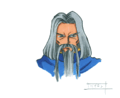
- Class concept illustrations
-
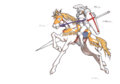
-
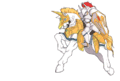
"Paladin 2". File is merely named "horse".
-
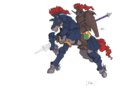
"Blackness Knight". No such grade exists in the final game.
-
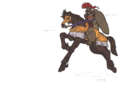
"Social Knight". Image labels it "T. Knight", and file is named "tnight".
-
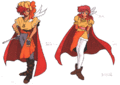
"Troubadour". Features a male Troubadour as well every bit a female one.
-
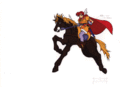
"Troubadour (female)".
-
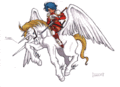
-
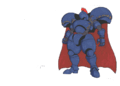
-
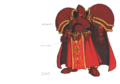
-
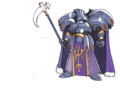
-
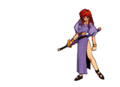
"Soldier (female)". The final game's Soldier class is unused and wields lances, though a Sword Soldier also exists.
-

"Swordfighter". The file name ("sfigter_f") specifies that it is a female version.
-
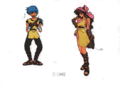
"Thief". The epitome labels the course with both its name from Genealogy (シーフ) along with its proper noun from previous titles (盗賊) in parentheses.
-
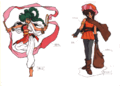
"Dancer". The art on the left is labeled with Dancer'south name from Mystery of the Emblem (踊り子). The art on the correct is labeled "T. Hunter" (T ハンター), probably continuing for "Treasure Hunter".
-
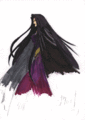
-
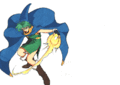
"Mage". Labeled on both the website and the image itself using the Mage's name from previous titles, 魔道士.
-
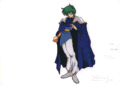
"Master Mage". The final game calls this class "Sage".
-
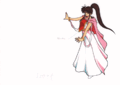
"Chief Mage (female)". The terminal game calls this class "Sage".
-
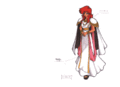
"Bishop (female)". The final game calls this form "High Priest", with Bishop being a separate, enemy-only form.
-
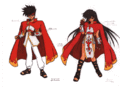
"Fire Mage". The image labels the class as "F. Mage" (F マージ).
-
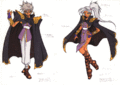
-
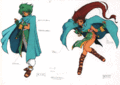
"Wind Mage". The website labels the form with a slightly different name from the game (ウィンドマージ instead of ウインドマージ). The image labels the class as "W. Mage" (W マージ)
- Package illustration proposals
-
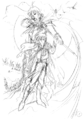
Proposal 1.
-
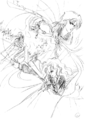
Proposal 2.
-
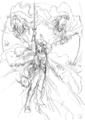
Proposal 3.
-
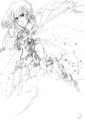
Proposal 4.
References
- ↑ Burn Emblem: Seisen no Keifu Release Data for SNES, GameFAQs, Retrieved: 2015-04-17
- ↑ 2.0 2.ane ii.two 2.3 Kaga, S.; trans. TheEnd, Official Guidebook, Serenes Forest, Published: 1996-10, Retrieved: 2015-04-17
- ↑ 3.0 3.1 Narihiro, T.; trans. Xkan, Toru Narihiro – Interview on evolution changes during Genealogy of the Holy War – FE 25th Anniversary, kantopia, Published: 2015-11-28 (trans. 2016-06-03), Retrieved: 2016-07-15
- ↑ Kaga, S.; trans. Amielleon, Kaga Interviews (Page 3/Q1), Fire Emblem (according to Japan), Published: 1999-01 (trans. 2013-02-22), Retrieved: 2015-02-24
- ↑ five.0 five.1 Kaga, Due south.; trans. Amielleon, Kaga Interviews (Page 3/Q2), Burn Emblem (according to Japan), Published: 1999-01 (trans. 2013-03-21), Retrieved: 2015-02-24
- ↑ Kaga, S.; trans. Amielleon, Kaga Interviews (P3~iv/Q4), Fire Emblem (co-ordinate to Japan), Published: 1999-01 (trans. 2014-x-01), Retrieved: 2015-02-24
- ↑ University of Japan Copyright Center, 日本ユニ著作権センター/判例全文・2002/11/14d 3, Translan, Published: 2002-11-fourteen, Retrieved: 2015-04-17
- ↑ History of Burn down Emblem, Fire Emblem (archived past Serenes Forest), Published: 2003, Retrieved: 2015-04-17
- ↑ ddstranslation, Burn down Emblem four: Genealogy of the Holy War Re-translation (Project Naga), Romhacking.net, Published: 2016-05-14
External links
- Fire Emblem: Genealogy of the Holy War official Japanese website
- Fire Keepsake: Genealogy of the Holy War Wii Virtual Panel website (Japanese)
- Burn Emblem: Genealogy of the Holy State of war Wii U Virtual Panel website (Japanese)
- Fire Emblem: Genealogy of the Holy War Fire Emblem Museum section (Japanese, archived by the Wayback Machine)
| Burn Keepsake: Genealogy of the Holy War | |||||||||||||||||||||||||||||||||||||
|---|---|---|---|---|---|---|---|---|---|---|---|---|---|---|---|---|---|---|---|---|---|---|---|---|---|---|---|---|---|---|---|---|---|---|---|---|---|
| |||||||||||||||||||||||||||||||||||||
| Burn Emblem series | ||||||||||||||
|---|---|---|---|---|---|---|---|---|---|---|---|---|---|---|
|
Source: https://fireemblemwiki.org/wiki/Fire_Emblem:_Genealogy_of_the_Holy_War
0 Response to "Fire Emblem Genealogy of the Holy War Box Art"
Post a Comment